 English
 Español
NEWS
NEWS
NEWS
NEWS
NEWS
NEWS
NEWS
NEWS
NEWS
NEWS
NEWS
NEWS
NEWS
NEWS
NEWS
NEWS

Industry News
Home / News / Industry News / How ECSS-Q-ST-70-02C Outgassing Testing Separates Space-Worthy Materials From the Rest
How ECSS-Q-ST-70-02C Outgassing Testing Separates Space-Worthy Materials From the Rest
Content
- 1 Why Outgassing Behavior Determines Whether a Material Ever Leaves the Lab
- 2 What ECSS-Q-ST-70-02C Actually Measures
- 3 Where Sample Transfer Becomes the Weak Link in the Process
- 4 Preparing Samples Before They Ever See a Thermal Vacuum Chamber
- 5 What Drives Test-to-Test Variability in Real Programs
- 6 Screening Test Versus Flight Hardware Bake-Out
- 7 Practical Considerations When Selecting a Chamber for This Work
- 8 Frequently Asked Questions
- 8.0.1 Q1: How long does a standard ECSS-Q-ST-70-02C outgassing test take?
- 8.0.2 Q2: Can a material that fails the total mass loss limit still be used with restrictions?
- 8.0.3 Q3: Why is a separate cold collector needed if the chamber walls are already cold?
- 8.0.4 Q4: Does humidity conditioning before the test affect the final result?
- 8.0.5 Q5: Is cryogenic pre-screening required before every outgassing test?
Why Outgassing Behavior Determines Whether a Material Ever Leaves the Lab
A material that performs perfectly on a bench in a normal atmosphere can behave very differently once it is placed inside a hard vacuum and cycled through temperature extremes. Polymers, adhesives, conformal coatings, and even some metals release trapped volatiles once ambient pressure drops low enough, and that release does not stop until the material reaches a new equilibrium. For a satellite, that off-gassed material does not simply disappear. It travels through the vacuum environment and condenses on the first cold surface it encounters, which is frequently an optical lens, a thermal radiator, or a solar cell.
This is the practical reason thermal vacuum chamber test programs exist, and why the ECSS-Q-ST-70-02C standard is treated as a gating requirement rather than a suggestion on most European space hardware programs. Outgassing testing is not about proving a material is strong or thermally stable in isolation. It is about proving that a material will not contaminate everything downstream of it once it is exposed to space-like conditions for the mission duration.
What ECSS-Q-ST-70-02C Actually Measures
The standard defines a screening test that runs a small material sample through a controlled thermal vacuum bake-out and measures three quantities that describe how much mass the sample loses and where that mass ends up. Rather than working from a single number, the test produces a small dataset that a materials review board can compare against fixed acceptance limits.
| Parameter | What It Represents | Typical Acceptance Threshold |
|---|---|---|
| Total Mass Loss | Overall volatile content lost during bake-out | 1.0 percent by mass |
| Collected Volatile Condensable Material | Portion of lost mass that condenses on a cold collector | 0.1 percent by mass |
| Water Vapor Regained | Moisture reabsorbed after conditioning | Reported, not typically limiting |
The test is normally run for twenty four hours at an elevated bake-out temperature, with the sample held under high vacuum while a cooled quartz crystal microbalance or a cold plate collector sits nearby to catch anything the sample sheds. Because the collector is held at a fixed low temperature, it acts as a stand-in for the coldest optical or thermal surface the flight hardware is likely to encounter, which is exactly what a program needs to know before committing a material to a bill of materials.
Where Sample Transfer Becomes the Weak Link in the Process
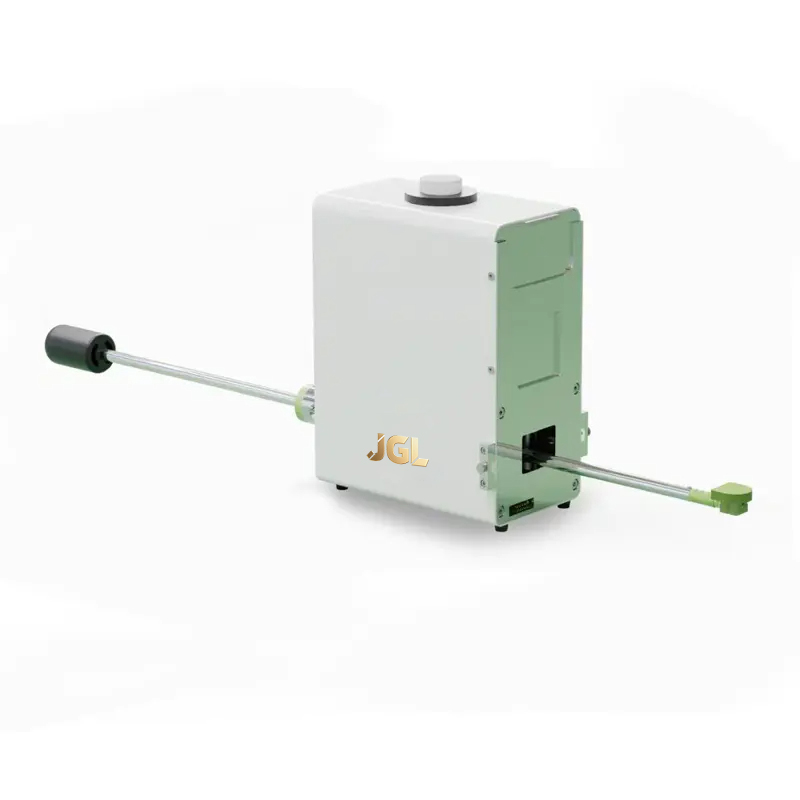
Outgassing results are only as trustworthy as the sample handling that precedes and follows the bake-out itself. A specimen that is exposed to ambient humidity between preparation and loading will regain moisture that skews the water vapor regained figure, and a sample that is handled with bare hands or exposed to airborne particulates can pick up surface contamination that has nothing to do with the bulk material being qualified. This is the practical justification for using a vacuum cryogenic sample transfer chamber as an intermediate step rather than moving specimens through open bench air.
A transfer chamber of this type maintains the sample under vacuum or inert atmosphere from the moment it leaves preparation through the moment it is loaded into the test chamber, which removes one of the most common sources of test-to-test variability that materials labs report. In practice, this matters most for three categories of specimen:
- Adhesives and potting compounds that are still curing and remain chemically active during transport
- Hygroscopic materials such as certain foams and composite laminates that absorb moisture quickly once exposed to room air
- Pre-conditioned samples that have already been baked once and would otherwise need to be rebaked if humidity exposure invalidated the first cycle
Labs running high sample throughput frequently report that a dedicated cryogenic sample transfer systems reduces retest rates measurably, simply because fewer samples arrive at the main chamber already compromised by handling.
Preparing Samples Before They Ever See a Thermal Vacuum Chamber
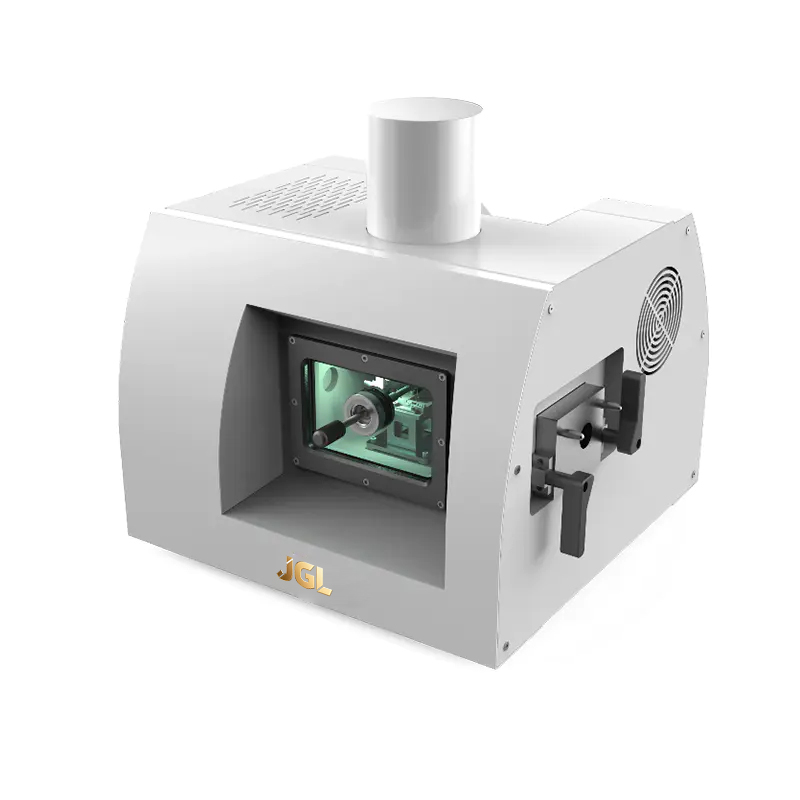
Before a sample is ever placed in a thermal vacuum chamber for outgassing screening, it typically passes through a conditioning stage where it is exposed to controlled low temperatures to check for cracking, delamination, or brittleness that would not show up at room temperature. A multi-functional cryogenic laboratory chamber is generally used for this step because it allows a lab to run cold soak conditioning, low-temperature mechanical screening, and sample storage within one enclosure rather than shuttling specimens between separate pieces of equipment.
This consolidation matters in a practical sense. Every time a sample changes environments, there is an opportunity for contamination, moisture pickup, or physical damage. A chamber that can hold a stable low-temperature environment for extended dwell periods, then release the sample directly into a transfer path toward the outgassing test chamber, shortens the number of handling steps and gives a more repeatable starting condition for the outgassing test itself.
Typical Pre-Conditioning Parameters
- Cold soak temperature range extending well below the mission's expected minimum operating temperature to add margin
- Dwell times long enough for the sample core to reach thermal equilibrium, not just the surface
- Controlled ramp rates to avoid inducing thermal shock damage that is unrelated to the material's actual space environment behavior
A Representative TVAC Outgassing Test Flow
The diagram below lays out the sequence a specimen typically follows from initial preparation through final reporting. The flow is presented as a loop rather than a straight line because most programs treat outgassing screening as an iterative process, where a failed sample is reformulated or resourced and sent back through the same steps.
What Drives Test-to-Test Variability in Real Programs
Labs that run outgassing screening at high volume tend to identify the same handful of root causes whenever a sample fails unexpectedly or produces inconsistent repeat results. None of these are exotic; they are almost always procedural rather than material-related.
Common Sources of False Failures
- Sample exposed to ambient air for an extended period between preparation and chamber loading, inflating the water vapor regained figure
- Inconsistent bake-out temperature control caused by poor thermal contact between the sample tray and the chamber's heated stage
- Collector surface not held at a stable enough temperature, allowing already-condensed material to partially re-evaporate during the test window
- Sample mass measured on a scale that was not itself temperature and humidity stabilized before the pre-test weighing
Correcting for these factors is less about upgrading equipment and more about tightening procedure. A chamber with strong environmental control does very little good if a sample sits in open room air for twenty minutes on the way to being loaded.
Screening Test Versus Flight Hardware Bake-Out
It is worth separating two activities that are often confused with each other. The ECSS-Q-ST-70-02C micro-VCM screening test qualifies a candidate material at the coupon level, generally using a sample only a few grams in mass. Flight hardware bake-out is a separate activity performed later, where the assembled unit itself is baked in a much larger thermal vacuum chamber to drive off residual volatiles before integration onto the spacecraft.
| Aspect | Material Screening Test | Flight Hardware Bake-Out |
|---|---|---|
| Sample Size | Small coupon, typically under 10 grams | Full assembled unit |
| Purpose | Approve or reject a candidate material | Remove residual volatiles before launch |
| Duration | Fixed 24 hour cycle | Variable, driven by monitored mass loss rate |
| Chamber Type | Compact thermal vacuum test chamber | Large-volume aerospace test chamber |
Programs that treat these as interchangeable steps often end up qualifying a material correctly but still discovering contamination issues at the assembly level, because a passing coupon result does not guarantee that a fully assembled unit built from that material will bake out cleanly within a practical schedule.
Practical Considerations When Selecting a Chamber for This Work
Not every vacuum cryogenics setup is suited to outgassing screening, even if it can reach the required pressure and temperature. A few characteristics tend to separate chambers that work well for this application from ones that create ongoing headaches for a lab.
- Clean pump-down path. Oil-based roughing pumps that are not properly trapped can introduce their own volatiles into the chamber, contaminating the very measurement the test is meant to make.
- Stable collector temperature control. The cold collector needs to hold its set point tightly throughout the full bake-out duration, since drift changes how much condensable material is captured versus lost.
- Low background outgassing from chamber materials themselves. Gasket materials, internal wiring insulation, and viewport seals should be selected with the same scrutiny applied to the test article.
- Traceable temperature logging. Reviewers evaluating a materials qualification package expect a continuous temperature record, not spot readings.
Frequently Asked Questions
Q1: How long does a standard ECSS-Q-ST-70-02C outgassing test take?
The core screening cycle runs for twenty four hours at the specified bake-out temperature under high vacuum, though sample preparation, chamber pump-down, and post-test analysis add time on either side of that window.
Q2: Can a material that fails the total mass loss limit still be used with restrictions?
In some cases yes, if the failure is marginal and the material is only used in a location far from sensitive optical or thermal surfaces, but this typically requires a formal waiver and additional contamination modeling rather than automatic approval.
Q3: Why is a separate cold collector needed if the chamber walls are already cold?
The collector is held at a specific, tightly controlled temperature that represents the coldest surface expected on the actual flight hardware, while chamber walls are usually at a different and less representative temperature.
Q4: Does humidity conditioning before the test affect the final result?
Yes. Samples are typically conditioned at a standard humidity and temperature before bake-out so that the water vapor regained measurement reflects a consistent starting point across different labs and test campaigns.
Q5: Is cryogenic pre-screening required before every outgassing test?
It is not universally mandated by the outgassing standard itself, but many programs add a low-temperature screening step as good practice to catch material defects that would not otherwise appear until later in the qualification sequence.
PREV:How MIL-STD-810 Environmental Test Chambers Turn Climatic Stress Into a Reliability Signal
NEXT:What Is HAST Testing Under JESD22-A110 and How Does It Predict Semiconductor Field Failures?
NEXT:What Is HAST Testing Under JESD22-A110 and How Does It Predict Semiconductor Field Failures?
Interested in cooperation or have questions?
Featured Products
Related products
Quick Link
Contact Information
- Tel: +86-13861043568
- E-mail: 1840784112@qq.com
- Add: Tianting District, Changzhou City, Jiangsu Province, China, No. 6 Hecircuit
Scan Code
Copyright © JIANGSU BAISHENG INDUSTRIAL CO., LTD.
All Rights Reserved. Privacy Custom Precision Laboratory Testing Equipment Manufacturers
