 English
 Español

NEWS
NEWS
NEWS
NEWS
NEWS
NEWS
NEWS
NEWS
NEWS
NEWS
NEWS
NEWS
NEWS
NEWS
NEWS
NEWS

Industry News
Home / News / Industry News / Environmental Simulation Testing: Chamber Selection, Specs and Test Standards
Environmental Simulation Testing: Chamber Selection, Specs and Test Standards
Content
A specification that reads "-40 °C to +125 °C, 1,000 cycles, 10 °C/min" looks reassuring until someone asks whether that ramp rate is linear or averaged, whether it was measured with an empty chamber, and how uniform the air is where the sample actually sits. Most qualification programmes that fail late fail on one of those three details.
The short version: environmental simulation testing is a repeatability problem before it is a capability problem. Extremes are easy to advertise; holding a defined tolerance on a loaded chamber, cycle after cycle, is what produces evidence a customer or a regulator will accept.
A chamber earns its place in a laboratory through control tolerances and reproducibility, not through the coldest number on its badge.
What Environmental Simulation Testing Reproduces
Environmental simulation testing subjects a product to controlled, artificially generated conditions that approximate what it will meet in service: temperature swings, humidity, salt atmosphere, rapid thermal change, vacuum, and combinations of those. The goal is not to reach a number. It is to accelerate a specific failure mechanism repeatably, so a failure can be traced to a cause and a fix can be verified.
The test is a failure mechanism, not a temperature
Two laboratories can run the same profile and reach opposite conclusions, because a profile describes only the stress applied to the outside of a product. What fails inside depends on the mechanism under investigation:
- Thermal fatigue: expansion and contraction between materials with different coefficients, cracking solder joints and bond interfaces.
- Moisture ingress: vapour diffusion into polymers and across surface contamination, producing leakage current and electrochemical migration.
- Corrosion: salt fog and condensing humidity attacking plating, connectors and fasteners.
- Material degradation: ultraviolet exposure, ozone and vacuum outgassing that contaminates optics and sensors.
- Combined loading: vibration plus temperature, which exposes mounting failures that single-stress testing misses.
Standards set the profile, the chamber sets the confidence
IEC 60068-2-1 and IEC 60068-2-2 fix cold and dry heat, IEC 60068-2-14 covers temperature change, IEC 60068-2-30 cyclic damp heat, ISO 16750-4 automotive electronics, ASTM B117 salt spray, JESD22-A110 accelerated damp heat, and ICH Q1A pharmaceutical stability. Defence programmes usually take the profile from MIL-STD-810 methods, where ramp and dwell tolerances become contractual evidence; this review of MIL-STD-810 chamber requirements shows how those methods translate into equipment specifications.
Matching Each Stressor to the Right Chamber Class
Chamber classes are not interchangeable, and buying a larger version of the wrong one is the most expensive mistake in this category.
| Stressor | Chamber class | Decisive specification | Typical standard |
|---|---|---|---|
| Steady cold or dry heat | High and low temperature chamber | Uniformity and fluctuation | IEC 60068-2-1 / 2-2 |
| Cyclic temperature with humidity | Temperature and humidity chamber | Humidity tolerance at temperature | IEC 60068-2-30 |
| Rapid temperature change | Rapid-rate temperature chamber | Linear ramp rate under load | IEC 60068-2-14 |
| Abrupt thermal shock | Two-zone shock chamber | Transfer time and recovery time | JESD22-A104 |
| Accelerated damp heat with bias | HAST pressure chamber | Saturation control and bias integrity | JESD22-A110 |
| Salt atmosphere | Salt spray cabinet | Fog deposition rate and pH | ASTM B117 |
| Flammable vapour from the DUT | Explosion-proof chamber | Purge, interlock, pressure relief | Product safety practice |
| Large assemblies or cabinets | Walk-in chamber | Air circulation across a large volume | Customer test procedure |
Thermal shock and rapid temperature change are not the same test
In a two-zone shock chamber the specimen moves between cold and hot air baths, so the stress is an abrupt surface step and transfer time becomes the controlling number, usually capped between 10 seconds and 5 minutes depending on the method. A rapid-rate chamber changes the air temperature inside a single volume at 5 to 15 °C/min, producing a slower gradient through the product. Substituting one for the other is a routine audit finding.
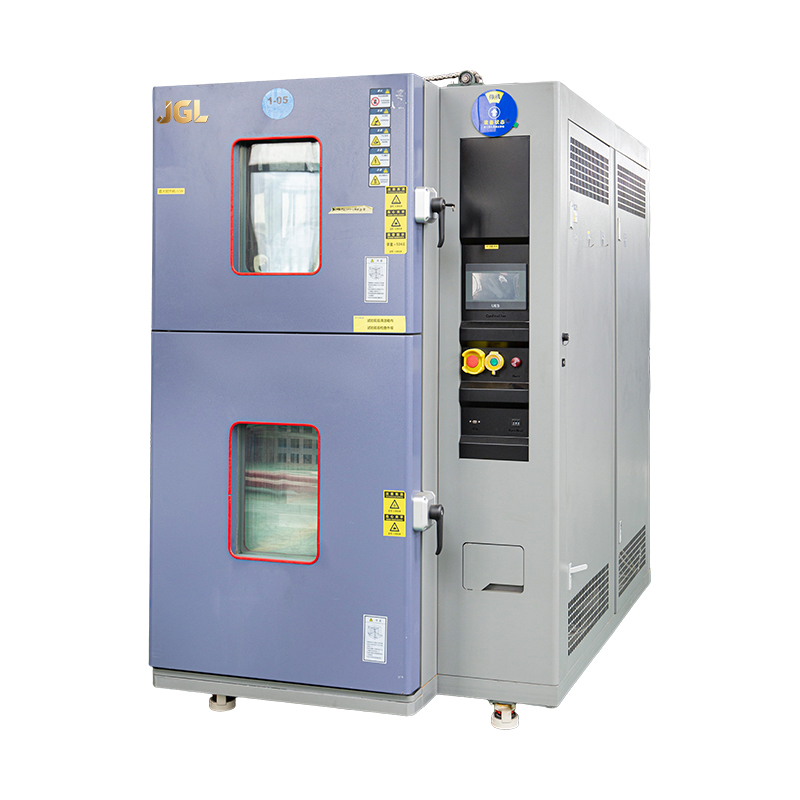
 U2S-100-A/W Two-Compartment Thermal Shock ChamberTwo-compartment thermal shock chamber with movable basket, designed for abrupt cold/thermal shock testing where transfer time controls specimen stress.View Product →
Humidity control is where cheap chambers lose credibility
Relative humidity is a derived value: it depends on dry-bulb and wet-bulb measurement, water quality, and the system's ability to manage condensation. Ask for a stated tolerance at the extremes of your temperature range, and confirm the chamber can hold 85% RH at 85 °C if your standard requires it. Many cannot.
Which Specifications Decide Whether Your Data Is Defensible
Four numbers separate a chamber that produces evidence from one that produces activity. Ask for all four, at your load, in writing.
Spatial uniformity
Spread between the coldest and warmest points in the working volume, typically ±0.5 °C to ±2 °C.
Fluctuation
Variation over time at a fixed point after stabilisation, often ±0.3 °C to ±0.5 °C.
Ramp rate
Linear or averaged, and always stated against a defined load.
Recovery time
How fast the chamber returns to setpoint after door opening or a heat-dissipating DUT.
Ramp rate without a load definition is marketing
A chamber sold at 15 °C/min empty may deliver 2 to 3 °C/min with a 30 kg aluminium fixture and a 300 W live load inside. The figure is not dishonest; it is simply measured under conditions no real test reproduces. Ask for ramp verification with a representative load and the sensor positioned where the product will sit, and keep the specimen under roughly one third of the working volume with about 50 mm clearance to walls and air outlets.
Control, logging and utilities
Segment programming and edit history support traceability; independent sensor ports let you prove what the DUT actually saw; over-temperature cut-outs, interlocks and alarm logs cover safety and audit together. Calibration should be traceable, and the logger must sample faster than the shortest ramp segment. Cooling water, drainage and the room's ability to absorb rejected heat are usually discovered at commissioning rather than at quotation.
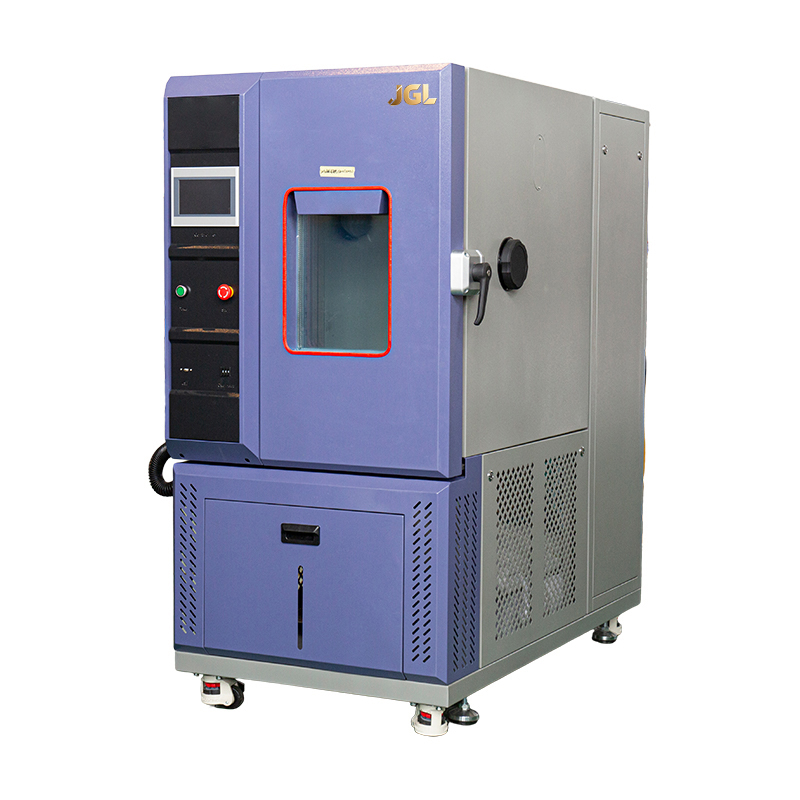
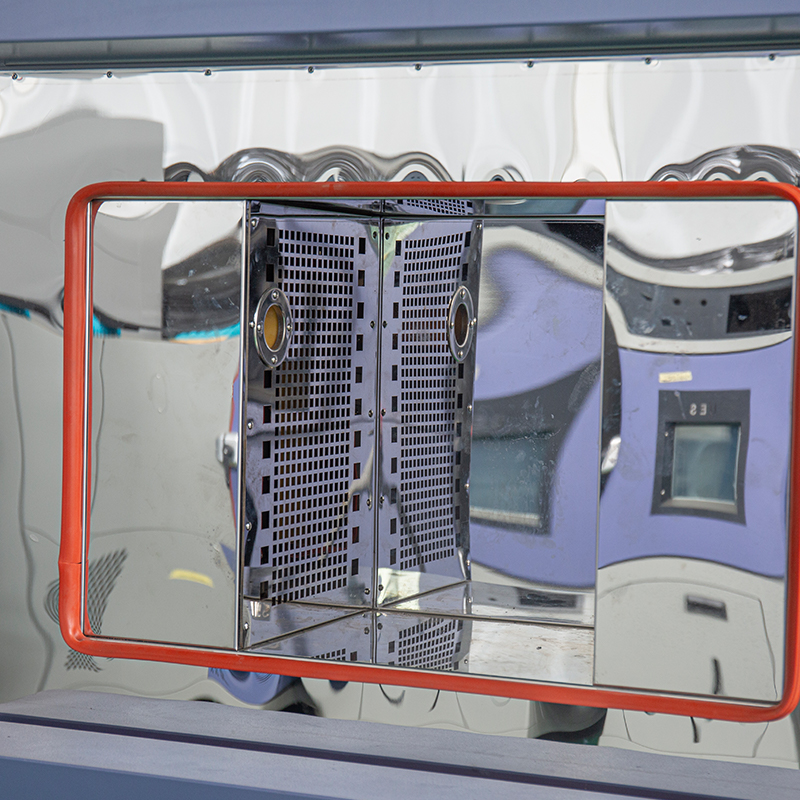 U5QTH-100-A/W Fast Temperature and Humidity Cycling ChamberFast temperature and humidity cycling chamber with 5–20°C/min rates and 100 L capacity, aimed at environmental reliability tests requiring rapid changes.View Product →
A Practical Selection Checklist
Work through these in order; each step removes options rather than adding them.
- Write the profile from the standard first: severity, dwell times, cycle count, permitted tolerance.
- Define the load: mass, material, fixture, heat dissipation in watts.
- Size the working volume so the specimen takes no more than one third of it.
- Confirm the required ramp rate is achievable with that load, and ask for evidence.
- Decide where the control sensor sits and whether you can add an independent one.
- List feedthroughs, ports and cable access before ordering, not after.
- Match safety design to risk: over-temperature protection, interlock, and purge or explosion-proof construction where the DUT can vent.
- Settle calibration, spares, service response and operator training in the contract.
The expensive problems are rarely mechanical. A late chamber misses a qualification window that has already opened; a humidity system fed untreated water scales up within months; a cold-soaked assembly opened in a warm room condenses water inside and fails the next electrical test for reasons unrelated to its design; and a controller that exports only proprietary formats becomes an obstacle the first time a customer asks for raw data.
Where Environmental Simulation Testing Is Applied
The equipment overlaps between sectors; the profiles and the acceptance criteria do not.
Automotive and electric vehicles
Power electronics, battery packs and under-hood parts run ISO 16750-4 and IEC 60068-2-30 profiles that combine thermal cycling with humidity, often with vibration added. Battery abuse testing adds another constraint: if a cell can vent flammable electrolyte, the chamber needs purging, interlocks and pressure relief rather than a standard door gasket.
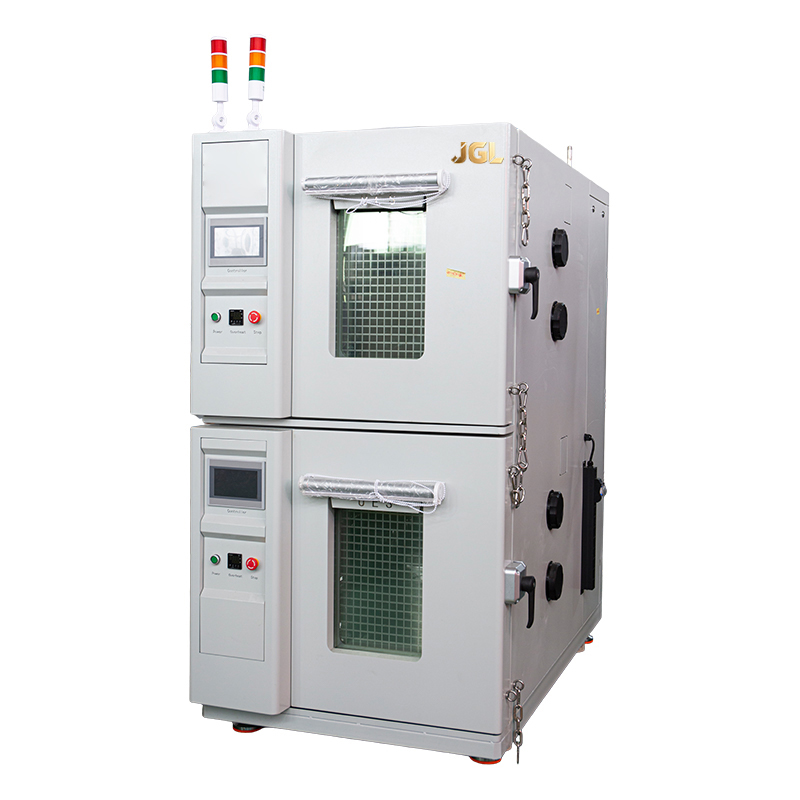
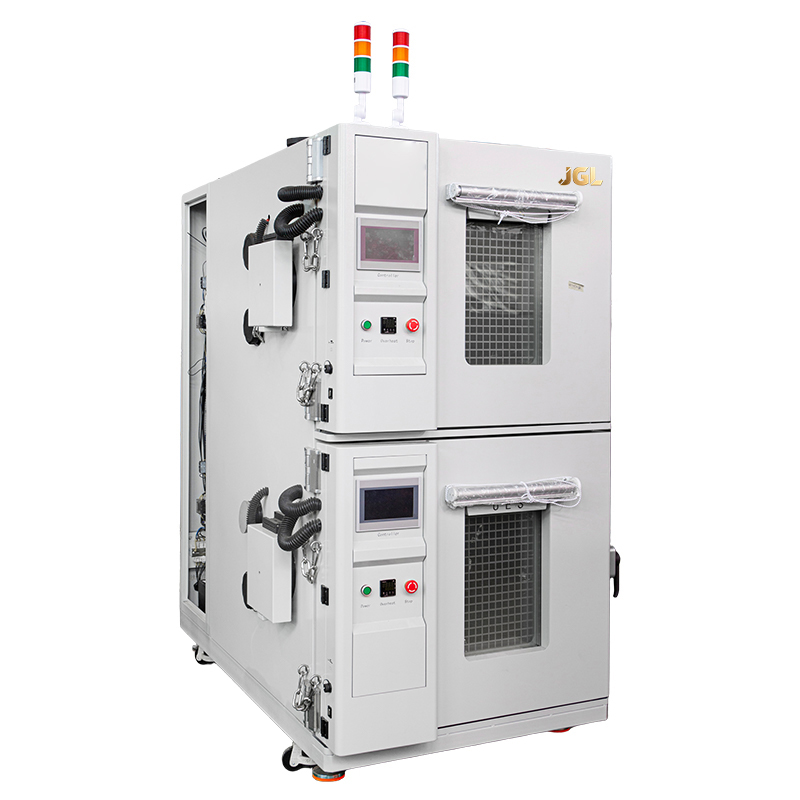 U2T(H)-EX150-A Dual-Layer Explosion-Proof Thermal Test ChamberDual-layer explosion-proof chamber with separate upper/lower compartments, fire extinguishing, smoke detection, and pressure relief for extreme-temperature electronics and battery testing.View Product →
Electronics and semiconductors
Board-level reliability work uses thermal cycling to expose solder joint fatigue and damp heat to expose moisture-driven failure, then pairs those results with withstanding voltage and insulation resistance checks on the same hardware.
Pharmaceutical and life science laboratories
ICH Q1A stability studies run for months at fixed combinations such as 25 °C and 60% RH or 40 °C and 75% RH, where long-term control stability and uninterrupted logging matter more than ramp speed.
Aerospace and materials research
Space hardware is screened for outgassing under vacuum and for thermal vacuum cycling, while materials work adds cryogenic handling in which samples move between preparation, transfer and analysis without warming or contamination.
Questions Buyers Ask Before Committing
Q1: How long should a thermal cycling test run?
Long enough for the failure mechanism to develop, which is why standards specify cycles rather than hours. A 1,000-cycle profile with 90-minute cycles occupies roughly nine weeks of chamber time, so uptime and unattended overnight operation matter as much as the temperature range.
Q2: What is the difference between environmental simulation and environmental stimulation testing?
Simulation reproduces the service conditions a product will meet; stimulation applies an external stimulus, such as electrical bias or mechanical excitation, to provoke a response during the test. Most reliability programmes use both at once, with a powered DUT inside a simulated climate.
Q3: Can one chamber handle both temperature and humidity?
Usually yes, but check the humidity envelope. Many chambers that reach 98% RH at 25 °C cannot hold 85% RH at 85 °C, so verify the exact combinations your standard calls for before signing.
Q4: When is an explosion-proof chamber required?
When the DUT can release flammable gas or vapour, such as venting cells or solvent-bearing samples. Expect a purge cycle before energising, door interlocks, and pressure relief sized for the worst-case release.
The discipline that pays off is treating a chamber as a measurement instrument rather than a room with a door. The profile comes from the standard, the load comes from the real product, and the confidence comes from uniformity, fluctuation and ramp control that were verified the way you intend to test.
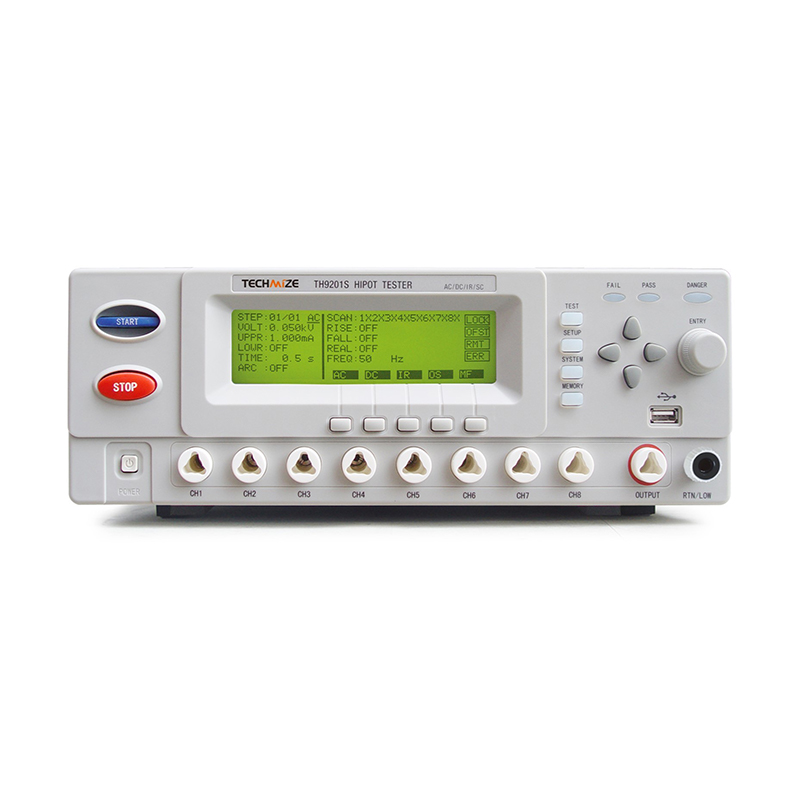
JIANGSU BAISHENG INDUSTRIAL has developed environmental test chambers, vacuum cryogenic handling equipment and electrical safety testers with its own engineering team since 2010, covering high and low temperature, rapid temperature change, thermal shock, explosion-proof and walk-in configurations. An overview of the range sits at the company product index.
PREV:Proper Transportation and Placement of Temperature & Humidity Test Chamber
NEXT:How Do You Measure the Dew Point? Instruments, Methods, and Lab Accuracy
NEXT:How Do You Measure the Dew Point? Instruments, Methods, and Lab Accuracy
Interested in cooperation or have questions?
Featured Products
Related products
Quick Link
Contact Information
- Tel: +86-13861043568
- E-mail: 1840784112@qq.com
- Add: Tianting District, Changzhou City, Jiangsu Province, China, No. 6 Hecircuit
Scan Code
Copyright © JIANGSU BAISHENG INDUSTRIAL CO., LTD.
All Rights Reserved. Privacy Custom Precision Laboratory Testing Equipment Manufacturers
