 English
 Español

NEWS
NEWS
NEWS
NEWS
NEWS
NEWS
NEWS
NEWS
NEWS
NEWS
NEWS
NEWS
NEWS
NEWS
NEWS
NEWS

Industry News
Home / News / Industry News / Similarities and Differences between Temperature-Humidity Alternating Test Chamber and High-Low Temperature Test Chamber
Similarities and Differences between Temperature-Humidity Alternating Test Chamber and High-Low Temperature Test Chamber
The performance of these two types of equipment is basically identical, while they differ in control modes. Both are used to pre-treat products and their contents through repeated temperature cycles from ambient temperature to low temperature and then to high temperature, followed by conventional tests. The purpose is to verify the products’ tolerance to various environments after simulating different circulation conditions, humidity variations and normal or extreme climates.
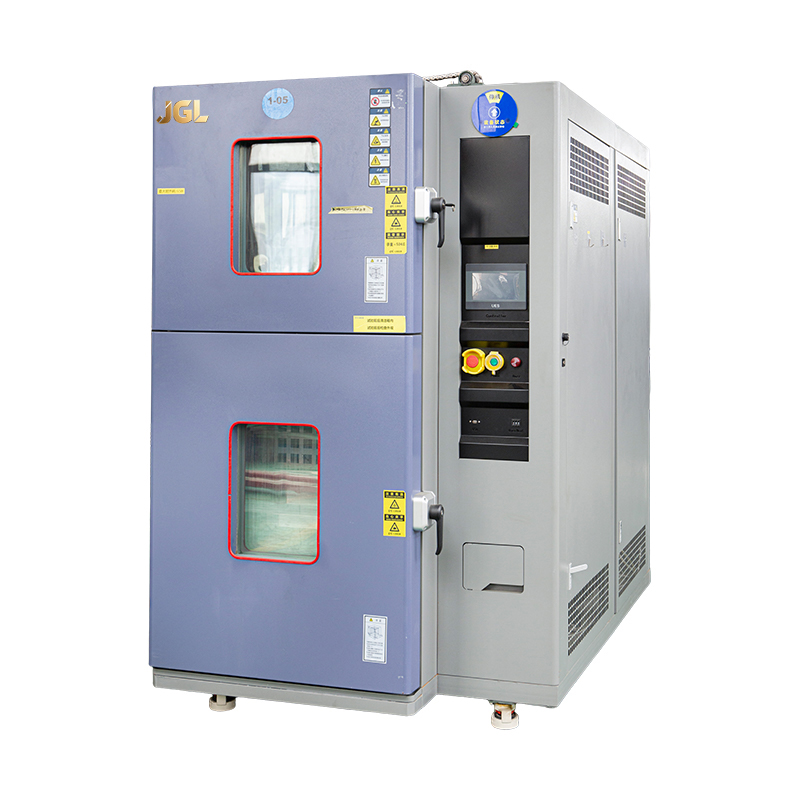
The main difference lies in the control unit. A high-low temperature test chamber is mostly controlled by a digital display meter, which is generally operated manually and only supports single-run commands. In contrast, a temperature-humidity alternating test chamber adopts a programmable controller for fully automatic operation. Test parameters and cycle times can be preset in advance, and the chamber will run according to the programmed sequence. They share basically the same chamber structure and technical specifications.
Working Principle of Temperature-Humidity Alternating Test Chamber
A temperature-humidity alternating test chamber consists of refrigeration system, heating system, control system, air circulation system and sensor system. These systems fall into two major categories: electrical system and mechanical refrigeration system. The working principles and processes of key systems are described as follows:
- Humidity System: It includes two subsystems for humidification and dehumidification.
- Control System: As the core of the chamber, it determines key indicators such as heating rate and control accuracy.
- Heating System: Compared with the refrigeration system, the heating system is relatively simple. It is mainly composed of high-power resistance wires. To meet the requirement of fast temperature rise, the heating system is equipped with relatively high power, and heaters are also installed on the bottom plate of the chamber.
- Refrigeration System: It is one of the critical components of the temperature-humidity alternating test chamber. Normally, it adopts mechanical refrigeration with optional liquid nitrogen auxiliary cooling. Mechanical refrigeration works on the vapor compression principle, and the system mainly comprises a compressor, condenser, throttling device and evaporator.
- Air Circulation System: It generally consists of a centrifugal fan and its driving motor to circulate air inside the test chamber.
- Sensor System: The chamber is mainly fitted with temperature and humidity sensors.
Need Custom Testing Equipment Solutions?
Get in touch with our engineering team for professional technical support and detailed product specifications.
Contact Us
PREV:No previous article
NEXT:Proper Transportation and Placement of Temperature & Humidity Test Chamber
NEXT:Proper Transportation and Placement of Temperature & Humidity Test Chamber
Interested in cooperation or have questions?
Featured Products
Related products
Quick Link
Contact Information
- Tel: +86-13861043568
- E-mail: 1840784112@qq.com
- Add: Tianting District, Changzhou City, Jiangsu Province, China, No. 6 Hecircuit
Scan Code
Copyright © JIANGSU BAISHENG INDUSTRIAL CO., LTD.
All Rights Reserved. Privacy Custom Precision Laboratory Testing Equipment Manufacturers
